
A moisturiser can feel like the obvious culprit when small bumps appear, but milia don’t always have a single, clear cause. If you’re searching for how to choose face moisturiser that will not cause milia, the most reassuring place to start is with a more realistic goal: finding a formula and routine that suit your skin, rather than trusting a promise of guaranteed results.
It’s understandable to look for labels such as “non-comedogenic” or “oil-free”, particularly when you’re trying to balance comfortable hydration with a texture that doesn’t feel too rich. These claims can offer clues, but they can’t predict exactly how your skin will respond. Milia are small, keratin-filled bumps, and a moisturiser may be only one factor among several.
This guide will help you assess texture, ingredients and how much product you use, while explaining what a moisturiser can realistically influence. You’ll also learn how to make cautious, personalised changes, so you can support your skin’s hydration without relying on misleading guarantees or overhauling your routine all at once.
Key Takeaways
- Learn how to choose face moisturiser that will not cause milia by weighing texture, intended use and personal comfort rather than relying on a “milia-safe” promise.
- Compare gels, lotions and richer creams by how they feel and fit your skin’s hydration needs; no texture alone guarantees suitability.
- Check how your moisturiser sits alongside other products, especially when several rich layers are applied to the same area.
- Introduce one new moisturiser at a time, follow its directions and keep other routine changes steady so you can better observe your skin.
- Use expert skincare curation to compare product categories and textures, while choosing according to your individual needs rather than a promise of prevention.
Choosing a face moisturiser to avoid milia: what to know
Milia aren’t proof that you chose the wrong moisturiser. These small bumps can appear for different reasons, and it isn’t always possible to identify a single cause. A product may feel too rich for your skin or seem to coincide with new bumps, but that alone doesn’t establish that it caused them.
Understanding what milia are can help you make a calmer, more informed choice. A moisturiser may influence how comfortable your skin feels and, for some people, whether a routine feels too heavy. It can’t guarantee prevention, though. The aim is to find a formula that suits your skin and use it thoughtfully, rather than search for a label that promises certainty.
What milia look like, and what they are not
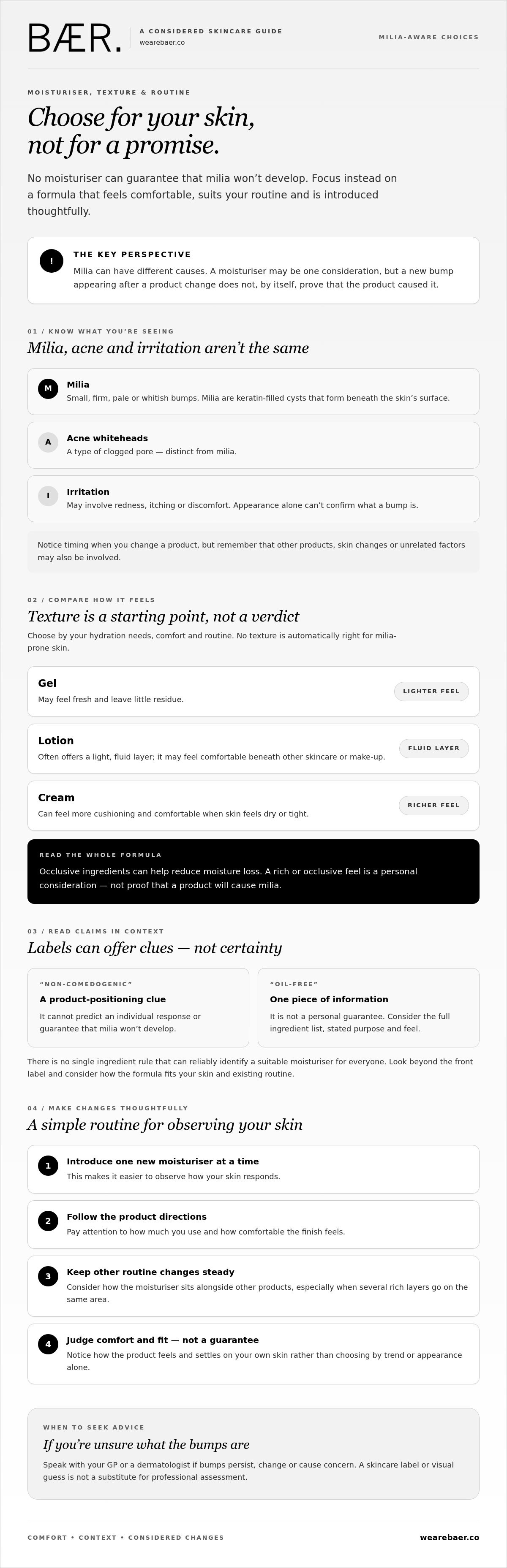
Milia often appear as small, firm, pale or whitish bumps, commonly around the face. Milia are keratin-filled cysts that form beneath the skin’s surface. They’re not the same as acne whiteheads, which are a type of clogged pore, and they’re distinct from irritation, which may involve redness, itching or discomfort. However, appearance alone can’t confirm what a bump is.
If bumps appear after you change moisturiser, the timing is worth noticing, but it doesn’t prove cause and effect. Other products, skin changes or unrelated factors may also be involved. Avoid assuming every pale bump is milia or repeatedly changing products in an attempt to diagnose it yourself.
Can a face moisturiser cause milia?
Milia have varied potential causes and aren’t simply blocked pores. Skin changes or damage may be relevant in some cases, whilst heavy creams are also discussed as a possible consideration. That doesn’t make rich or occlusive moisturisers a universal cause: individual skin, application and the rest of a routine can all affect how a product feels and sits.
No moisturiser label can guarantee that milia won’t develop. Terms such as “non-comedogenic” may help describe a product’s intended use, but they can’t predict an individual response or rule out other causes. As you consider how to choose face moisturiser that will not cause milia, focus on comfort, amount used and how the formula fits with other products, not a promise of prevention.
If bumps persist, change, or you’re unsure what they are, speak with your GP or a dermatologist for an assessment. This is particularly sensible if they’re causing concern; a skincare label or visual guess isn’t a substitute for professional advice.
How moisturiser texture and ingredients affect a milia-aware choice
Texture is a useful starting point, not a verdict. A gel may feel fresh and leave little residue, whilst a lotion often offers a light, fluid layer. A richer cream can feel more cushioning and comfortable when skin feels dry or tight. Those sensory differences can help you judge whether a product suits your preferences and routine, but they can’t tell you in advance how your skin will respond.
Light lotion, gel or cream: which texture should you try?
If you dislike a heavy finish, a gel or lighter lotion may feel more comfortable, particularly beneath other skincare or make-up. If your skin feels dry or tight, a cream may provide the more reassuring, cushioned feel you want. Neither texture is automatically the right choice for milia-prone skin. Compare how each feels and settles on your own skin, rather than choosing by trend or appearance alone.
Consider the whole formula as well as its finish. Occlusive ingredients can help reduce moisture loss, but a rich or occlusive feel is a personal consideration, not proof that a product will cause milia. Skin needs and routines vary. MedlinePlus explains what milia are; this context is a reminder that choosing a moisturiser is not a guaranteed way to prevent them.
How to read non-comedogenic and oil-free claims
“Non-comedogenic” and “oil-free” may help describe a product’s positioning, but neither promises that you’ll avoid milia. Look beyond the front label: read the full ingredient list, consider the product’s stated purpose and reflect on how its texture fits your skin and existing routine. There’s no single ingredient rule that can reliably identify a suitable moisturiser for everyone.
As you consider how to choose face moisturiser that will not cause milia, treat a label as one piece of information, not a personal guarantee. Notice whether the product leaves a finish you enjoy, whether your skin feels comfortable afterwards and whether you’re layering it with other rich formulas over the same area. These practical observations can guide a considered choice without turning one ingredient or texture into a universal rule.
If comparing formulas feels difficult, BÆR. offers a curated skincare selection that can help you explore product categories and textures. You can also browse the curated skincare selection and assess each option against its current ingredient list and your own preferences.
How to compare face moisturisers without relying on milia-safe claims
Instead of searching for a guaranteed “milia-safe” formula, compare how each moisturiser is designed to be used and how it fits your skin. A lighter-feeling product may be worth trying if you prefer less residue, but that’s a preference to assess, not a promise that milia won’t appear. Ingredient lists can inform your decision, yet they can’t predict every individual response.
Use the same criteria for each option. A simple note on your phone can make differences easier to assess:
- Texture and finish: Is it fluid, gel-like or rich? Does it leave a fresh, dewy or more substantial feel?
- Stated purpose: Is it intended as a daily face moisturiser, or does the product have another specific use?
- Skin comfort: Does your skin feel comfortable after application, or does the finish feel heavier than you prefer?
- Routine fit: How does it sit alongside your other products, and does your skin feel dry or tight without a more cushioning layer?
- Full ingredient list: Compare the complete lists, but don’t treat a single ingredient as a universal trigger or a guarantee of suitability.
A simple checklist for comparing two formulas
Imagine you’re choosing between a light lotion and a richer cream. Note each one’s texture, finish and stated purpose, then consider which better meets your current comfort needs. If your skin feels dry, a lighter option isn’t automatically the better match. Ingredient references can provide context: for example, Healthline discusses how ingredients in skin care and makeup products may be associated with milia. Use this as a prompt to review a formula, not as a definitive blacklist; your overall response matters too.
When richer products or layering deserve a closer look
Review how often you apply a rich cream, balm or other occlusive product to the same area. Several substantial layers may leave a finish that feels uncomfortable, even though this alone doesn’t establish the cause of bumps. Texture, quantity and layering can all shape how a moisturiser feels. Follow the product directions, avoid adding more than you need, and change one product at a time so you can assess your routine more clearly.
This measured comparison is central to how to choose face moisturiser that will not cause milia: assess purpose, comfort and routine fit rather than expecting an ingredient or texture to guarantee prevention. Keep your existing routine steady while you evaluate a new option. If bumps persist or you’re uncertain about them, seek advice from a GP or dermatologist rather than trying to identify the cause through product changes alone.
How to introduce a moisturiser and monitor your skin
A careful introduction makes it easier to notice whether a moisturiser feels comfortable, without assuming every change in your skin has the same cause. Add one new product at a time and keep the rest of your routine steady where practical. If you introduce several products together, it becomes harder to tell which one may be affecting your skin.
A measured way to try a new face moisturiser
Start by reading the product directions, including where and how often it’s intended to be used. Apply a modest amount to the intended area; more product isn’t necessarily more comfortable. Avoid adding several rich layers over the same area unless your routine calls for them. Then pay attention to how your skin feels and looks during normal use, without expecting a particular result by a fixed date.
A brief note can help you keep track: record when you started, how the formula feels after application, and any visible changes or discomfort. This is not a diagnostic test, but it may help you make a more considered decision about whether to continue. If clear irritation develops, pause use. Seek professional advice if symptoms concern you, rather than trying to manage a reaction by adding more products.
When to ask a clinician about persistent bumps
Don’t squeeze, scrape or pick at bumps. If they persist, change, or you’re unsure what they are, ask your GP or a dermatologist for an assessment. Seek advice sooner if they’re painful, markedly inflamed, changing rapidly or close to the eyes. A clinician can help clarify what you’re seeing; a moisturiser trial can’t confirm a diagnosis.
Redness, sensitivity or discomfort may also prompt you to review your routine and learn about signs of a damaged skin barrier. These symptoms can have different explanations, so avoid self-diagnosing or using exfoliating products to try to remove bumps without appropriate advice. If your concern is persistent or unclear, professional guidance is the more considered next step.
Choosing a moisturiser thoughtfully is a process of observation, not a guarantee of prevention. If you’d like to compare skincare categories and textures, explore the curated skincare selection at BÆR.
How expert skincare curation can help you choose with confidence
Once you’ve considered how a moisturiser feels and fits into your routine, the next step is a choice grounded in your own preferences, not a promise of milia prevention. A curated skincare edit can make comparison feel more considered by bringing product categories and textures together, helping you explore what might suit your routine without treating any formula as universally right.
What a curated skincare edit can and cannot do
Expert curation can help narrow the field and make it easier to compare a product’s intended use with its texture and current ingredient list. It can’t establish what a bump is, diagnose a skin condition or guarantee how your skin will respond. Before choosing, check the latest product information and ingredients, particularly if you have known sensitivities or are trying to understand a change in your routine.
BÆR. is an independent UK luxury beauty retailer with a curated skincare selection. MANTLE The Barrier Cream is one confirmed offering to assess against your individual preferences and its current product information. Its inclusion here isn’t a claim that it prevents milia, treats them or is guaranteed not to contribute to bumps. Take your time; the most useful choice is one that feels comfortable and makes sense within your own routine.
When to seek personalised skincare guidance
A knowledgeable beauty professional may be able to help you describe the textures you enjoy, how you use skincare and any sensitivities you’ve noticed. This kind of conversation can support product discovery, but it isn’t a medical assessment. If bumps are persistent, changing or difficult to identify, speak with a GP or dermatologist rather than relying on retail advice to determine the cause.
The MANTLE by BÆR. Bespoke Facial is a beauty service, not medical aesthetics or a diagnostic appointment. If considering it, check its current scope and booking details, and use any discussion of skincare preferences as a complement to medical advice, not a substitute. The aim is informed, unhurried choice, without pressure to buy.
Ultimately, how to choose face moisturiser that will not cause milia is less about finding a guaranteed label and more about selecting a product that suits your needs, then paying attention to how it fits your routine. For a considered next step, explore BÆR.’s curated skincare selection.
Make your next moisturiser choice with confidence
The most useful answer to how to choose face moisturiser that will not cause milia isn’t a guaranteed-safe label. It’s a considered choice based on how a formula feels, what your skin needs and how it fits into your routine. Introduce changes thoughtfully, and seek professional advice if bumps persist or you’re unsure what they are.
Expert curation can make comparing skincare categories and textures feel more straightforward, without promising a particular result. BÆR. curates high-performance skincare brands, including MANTLE The Barrier Cream. If you’re considering it, review the current product information and ingredient list against your own preferences; no product should be treated as a guaranteed milia solution.
For a considered next step, explore BÆR.’s curated skincare selection and take time to compare options at your own pace. The right choice is the one that feels comfortable and makes sense for you. You can approach your routine with care, not guesswork.
Frequently Asked Questions
What type of moisturiser is best if I am prone to milia?
There isn’t one moisturiser type that’s best for everyone prone to milia. A gel or light lotion may suit you if you prefer a less substantial finish, whilst dry or tight-feeling skin may feel more comfortable with a richer cream. Consider how the formula feels, its intended use and how it fits your routine. As you think about how to choose face moisturiser that will not cause milia, treat texture as a personal preference to assess, not a guarantee.
Does non-comedogenic moisturiser prevent milia?
No. “Non-comedogenic” is not a promise that a moisturiser will prevent milia or suit every individual. It may offer a clue about the product’s intended positioning, but it can’t account for your skin, the amount you apply or other products in your routine. Read the full ingredient list and product directions, then consider how the formula feels in use. If bumps persist or you’re unsure what they are, seek clinical advice.
Should I avoid oil in a face moisturiser if I have milia?
Not necessarily. The presence of oil alone doesn’t establish that a moisturiser will cause milia, and avoiding every oil isn’t a universal rule. Consider the complete formula, its texture and how it feels on your skin, particularly if you’re layering it with other rich products. If you notice discomfort or a change after introducing a moisturiser, make a note of it rather than assuming one ingredient is responsible.
How can I test a new moisturiser if I am prone to milia?
Introduce one new moisturiser at a time, following its directions and using an appropriate amount on the intended area. Where practical, keep the rest of your routine steady so you can more clearly observe how your skin feels and looks. There’s no fixed testing period that can guarantee a result. Pause use if clear irritation develops, and ask a GP or dermatologist for advice if symptoms concern you.
Are milia the same as whiteheads?
No. Milia are small keratin-filled cysts beneath the skin’s surface, whereas whiteheads are a form of acne associated with clogged pores. They may look similar, so appearance alone can’t confirm which you have. Avoid squeezing or scraping bumps to find out, as this can irritate the skin. If you’re uncertain about their appearance or they persist, a GP or dermatologist can assess them.
When should I see a doctor about milia?
See your GP or a dermatologist if bumps persist, change, or you’re unsure what they are. Seek advice if they’re painful, markedly inflamed, changing rapidly or close to your eyes. These features don’t establish a diagnosis, but they’re good reasons to get professional guidance rather than trying to remove or identify the bumps yourself. Don’t squeeze or scrape them; a clinician can advise on the appropriate next step.