
Adding more foundation or powder can make cakey make-up more visible, not less. If you’re wondering how to fix cakey foundation on dry mature skin, the answer may not be a different foundation at all. Cakiness can come from a mismatch between skincare, formula and application, leaving make-up to cling to dry patches or gather in lines.
It’s frustrating when your base looks comfortable at first, then begins to separate or emphasise texture as the day goes on. You don’t necessarily need to remove it all. A light touch can soften areas that look dry and restore a more natural finish without adding another heavy layer.
This guide will help you identify what may be causing the problem, refresh your make-up gently and refine your routine for next time. We’ll cover skin preparation, foundation texture and coverage, application techniques and when to use powder, so you can make adjustments with less guesswork.
Key Takeaways
- Cakeyness can have several causes, so check your skincare, foundation and application before changing your whole routine.
- To learn how to fix cakey foundation on dry mature skin, start with a gentle, local adjustment rather than adding another layer.
- Match your approach to what you can see: excess product, dry patches and uneven texture may each need a different touch.
- Apply foundation sparingly, then pause and reassess before adding coverage or powder.
- Choose products by how they feel and wear on your skin, not by age-based labels alone.
Why foundation looks cakey on dry, mature skin
Cakey foundation can have several causes, and it doesn’t mean you need to give up make-up. The term describes a finish where product looks built up or patchy, or gathers in lines and dry areas instead of sitting evenly on the skin. Foundation comes in forms such as liquid, cream and powder. The best choice depends on the finish and feel you prefer.
Foundation may look uneven because of temporary dryness, too much product, a finish that doesn’t suit your skin’s current needs, or simply because it settles into natural skin texture. These causes can overlap, but they call for different adjustments. Adding coverage everywhere, for example, may not help if the issue is product gathering in one expression line.
Visible cakeyness often reflects product build-up, skin preparation and application, rather than one problem with foundation alone.
How to recognise dryness, excess product and settling
Look closely before reaching for another layer. Flaking or a tight-feeling area may suggest temporary dryness, while a patchy finish can indicate that coverage has worn away unevenly or is sitting on the surface. Product gathered around expression lines or textured areas looks more like concentrated build-up. Notice where the finish changes and whether the skin feels uncomfortable before deciding what to adjust.
Dryness doesn’t automatically mean your foundation is unsuitable. Too much skincare that hasn’t settled, excess foundation or a finish that feels too matte for your preference can all contribute to a heavier appearance. Skin may also become drier or change in texture over time, although everyone’s experience is different.
Why mature skin may need a lighter make-up approach
A lighter application can let natural skin texture remain visible without asking foundation to conceal every line. This isn’t about treating lines as flaws; it’s about choosing how much coverage feels comfortable and looks like you. If your skin feels persistently uncomfortable or dry, consider whether your skincare routine needs attention. You can also read this guide to signs of a damaged skin barrier for further context.
Understanding the cause is the first step in how to fix cakey foundation on dry mature skin. Observe the area in natural light, identify whether you’re seeing dryness, excess product or settling, then make one small change at a time.
How skincare, foundation and application can create a cakey finish
A cakey finish can develop before foundation is applied. A generous skincare routine may leave a slippery layer on the skin. If products haven’t settled, foundation can move or collect rather than blend evenly. At the other extreme, skin that feels uncomfortably dry may make coverage appear less smooth. Neither outcome means your routine is wrong; it may simply need adjusting to how your skin feels that day.
Foundation formula and finish are personal choices, not universal rules. Sheer, buildable coverage lets you add more only where you want it, while fuller coverage may suit a different preference. Products can also sit differently alongside particular skincare, so observe how your own combination wears rather than assuming an ingredient conflict. A smoother-looking base often starts with using less product in thinner layers.
When skin preparation is helping, or leaving too much behind
Choose a moisturising step that leaves your skin comfortable, then allow it to settle before applying foundation. If your face still feels slippery to the touch, pause rather than layering make-up over it straight away. Skin can change with age, including in texture and moisture; the National Institute on Aging explains some changes in mature skin. If dryness or discomfort persists, consult this guide to skin barrier health.
More skincare isn’t automatically better under make-up. If several layers leave a noticeable film, try simplifying your preparation and see whether foundation sits more comfortably. Change one thing at a time so you can tell what has helped.
How finish, coverage and tools change the result
Application technique affects how much product stays on the skin and where it concentrates. Repeated rubbing can disturb coverage that’s already uneven. Adding more foundation or powder over the top may make visible build-up more pronounced. Pressing product in with a damp sponge, using a brush or blending with clean fingertips can each give a different level of coverage and finish. There’s no single tool that suits everyone.
- For lighter coverage: try a small amount, spread it thinly, then build only where needed.
- For more coverage: apply gradually and check the finish before adding another layer.
- If the base looks uneven: avoid immediately rubbing or powdering over it. Test a gentler technique on one area first.
Keep the rest of your routine steady while you test a different tool, amount or finish. This makes it easier to identify what feels and looks right for your skin. For a considered selection of make-up and skincare, explore BÆR.’s curated beauty edit.
Which cakey-foundation fix should you choose?
The gentlest correction depends on what you can see. Pressing can smooth product that’s sitting unevenly; lifting can help where there’s simply too much. If an area looks dry, add moisture sparingly and only there. Use this as a guide, not a rule: your skin and products may respond differently.
| What you notice | Gentle action to try | What to bear in mind |
|---|---|---|
| Foundation looks thick or built up | With a clean, damp sponge, lightly press over the area. If product still looks excessive, gently lift some away with the sponge rather than adding more. | Pressing may redistribute product, but dragging or repeated dabbing can disturb the base. |
| A small area looks dry | Use a minimal amount of a suitable moisturising product on that patch, then reassess in natural light before deciding whether to touch up foundation. | Extra skincare can leave a film if you use too much or don’t let it settle. |
| Foundation has separated or remains patchy | If gentle pressing doesn’t help, remove foundation from that area and reapply a thin layer just there. | Reworking the whole face may create more build-up; match any new product to the surrounding finish. |
| Only certain areas look shiny | If needed, use a small amount of powder only on those areas. | Powder over dry patches or across the whole face can make dryness and texture more noticeable. |
Choose a touch-up for the symptom you can see
Start with the least disruptive option. For excess coverage, press gently with a damp sponge; if the surface still looks heavy, lift a little product away. For dry-looking areas, make a small, targeted adjustment and check the result in natural light. If foundation has visibly separated, removing and reapplying only that patch may leave a more even finish than layering over it.
When to stop adding product
Repeated layering, rubbing or powdering are useful cues to pause. Step back and check your make-up from a normal viewing distance, not just close to the mirror. If the finish looks comfortable at that distance, it may not need another correction. No single tool or product will suit every skin type, so let the result guide your next step.
These small choices offer a practical starting point for how to fix cakey foundation on dry mature skin without stripping away your whole base. For a considered approach to choosing make-up and skincare, explore BÆR.’s curated beauty selection.
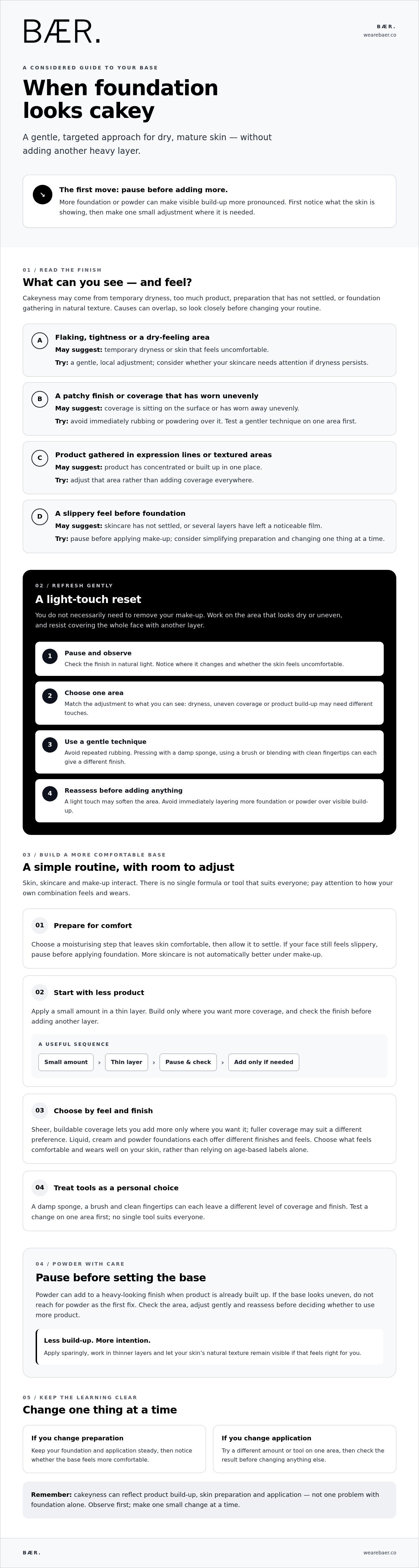
How to fix cakey foundation on dry, mature skin step by step
A cakey base doesn’t always need a full reset. Work on the area that looks uneven, use the lightest touch that could help and pause to assess before moving on. This measured approach to how to fix cakey foundation on dry mature skin can help you refresh your make-up without creating more layers across the face.
Remove excess first, then add only what the area needs.
- Start with clean hands and a close look. Check where foundation looks built up, patchy or dry. Use natural light if you can, and avoid treating the whole face when only one area needs attention.
- Blot excess carefully. If there’s oil or product sitting on the surface, gently press a clean tissue onto the area and lift it away. Don’t rub, particularly over dry-looking patches, as friction may disturb the base further. Reassess.
- Press down visible build-up. Use a clean sponge that’s slightly damp, not dripping, to lightly press over foundation that looks too thick. Avoid dragging it across the skin. Check the result before repeating.
- Lift a stubborn uneven patch. If pressing hasn’t helped and the area still looks separated or heavy, gently lift foundation from that patch with the sponge or a clean tissue. Keep the correction contained rather than removing make-up from the whole face.
- Replace only what’s needed. If you’ve lifted coverage, use a small amount of foundation on the affected area. Press or blend it gently, softening the edges into the surrounding base so the touch-up doesn’t look like a separate layer. Pause and inspect before adding more.
- Powder selectively, if you choose. If you want to reduce shine, use a light touch only where needed. Skip visibly dry areas, and don’t automatically powder the whole face.
Adjust coverage without emphasising texture
Step back from the mirror and look at your complexion from a normal viewing distance. The aim is a balanced finish, not a completely texture-free one. If the area looks comfortable and even enough, stop there. Further rubbing, layering or powdering can make the original unevenness more noticeable, so let the result guide you rather than chasing perfection.
For make-up and skincare chosen with a considered approach, explore BÆR’s curated beauty selection.
Prevent cakey foundation with a considered routine and product choice
A reliable routine doesn’t need to be elaborate. Prepare your skin with a comfortable amount of skincare, give it time to settle, then apply a thin layer of foundation. Pause to inspect the finish before adding coverage. This simple prepare, apply and reassess rhythm can help you spot what suits your skin, rather than changing several products or techniques at once.
Build a routine around comfort and the finish you prefer
Adjust coverage to the area: you might want more where you’d like extra evening-out, and less where product tends to gather. A brush, clean fingertips or a damp sponge can each create a different result, so test one change at a time. Notice how your skin feels, how the finish looks in natural light and how it wears through the day. Age-based labels alone won’t tell you whether a formula or finish is right for you.
Explore considered product and personalised guidance
A curated selection can be a more thoughtful starting point than layering products in the hope that one will solve everything. BÆR. carries MANTLE The Barrier Cream and 19/99 BEAUTY Cream Highlight Stick. Their presence here is an invitation to explore, not a promise that either will suit every skin or produce a particular finish. You can also find related make-up perspective in 19/99 Beauty’s guide to ageless, high-performance make-up.
If you’d value a more personal approach to skincare, the MANTLE by BÆR Bespoke Facial is an optional in-store service to explore. It isn’t a medical treatment. Ultimately, learning how to fix cakey foundation on dry mature skin is about making measured adjustments and choosing what feels comfortable on your own skin. Discover BÆR.’s curated beauty edit.
Make your foundation routine feel more comfortable
Cakey foundation doesn’t automatically mean your foundation is wrong or that you need to start again. The finish can be affected by skin preparation, product amount, formula and application, so take a moment to identify what’s happening before making a change. For a quick refresh, gently lift excess product, press the remaining base and add coverage only where it’s needed.
To help prevent it next time, keep skincare measured, let it settle and begin with a light layer of foundation. Check the finish before adding more, and pay attention to comfort and wear throughout the day. Learning how to fix cakey foundation on dry mature skin is less about concealing every line and more about finding an approach that feels right for you.
BÆR. offers a curated make-up and skincare selection including Danessa Myricks Beauty, MANTLE and 19/99 BEAUTY. For personalised, non-medical skincare guidance, the MANTLE by BÆR Bespoke Facial is another option to explore. Explore BÆR.’s curated beauty selection and take your next step towards a base that feels more comfortable and looks naturally your own.
Frequently Asked Questions
How do you fix cakey foundation on dry skin without removing it all?
Gently press the uneven area with a clean, slightly damp sponge, then reassess before doing anything else. If product looks excessive, lift a little rather than adding another layer. For a patch that remains uneven, remove foundation only from that area and apply a thin layer selectively. This is a practical way to learn how to fix cakey foundation on dry mature skin without disturbing the rest of your make-up.
Why does my foundation look cakey on mature skin?
Foundation can look cakey when it builds up, clings to dry areas or gathers in lines. The result may also be influenced by how much skincare or foundation you’ve applied, whether skincare has settled and the finish you prefer. Skin can become drier or change in texture over time, but everyone’s experience is different. Look closely at where the finish changes before deciding whether to adjust preparation, coverage or technique.
Can moisturiser fix cakey foundation?
Moisturiser may help if a small area looks dry, but applying it over make-up won’t suit every situation. Use a very small amount only where needed, and press it in gently rather than rubbing. Too much can leave the surface slippery or disturb the foundation, so check the result before adding coverage. If the base is simply too thick or has separated, lifting or removing product from that patch may be more effective.
Should I use powder on dry, mature skin?
You can use powder selectively if you want to reduce shine, but it isn’t essential across the whole face. Apply a small amount only where needed and avoid dry-looking areas, where powder may make texture more noticeable. If your foundation already looks heavy, adding powder can increase the sense of build-up. Check the finish from a normal viewing distance before deciding whether another touch-up is necessary.
How do I stop foundation settling into fine lines?
Use less foundation around expression lines and apply it in a thin layer, adding coverage only where you want it. Let skincare settle before make-up, then press foundation gently into the skin rather than repeatedly rubbing over the same area. If product gathers in a line during the day, lightly lift the excess and reassess. Natural lines are part of skin texture, so aim for a comfortable, balanced finish rather than trying to erase them.
Is a damp sponge or brush better for applying foundation on dry skin?
Neither tool is best for everyone. A clean, slightly damp sponge can help press on a light layer, while a brush may give you a different level of coverage and finish. Clean fingertips are another option. Try one tool at a time using a small amount of foundation, then compare how the base looks and feels. Gentle application matters more than choosing a particular tool, especially if your skin is feeling dry.
Should I start again if my foundation has separated or gone patchy?
Not necessarily. If the separation is limited to one area, try pressing it gently with a clean, slightly damp sponge. If it remains patchy, remove foundation from that section and apply a thin layer again, blending the edges into the surrounding base. Starting over across the whole face may add unnecessary effort and product. If the finish is uneven everywhere, a fresh base may be simpler than repeated rubbing and layering.