
What if the right choice isn’t serum or cream, but the role your skin needs a product to play? The question of ceramide serum vs barrier repair cream can feel like a choice between two competing essentials, especially when both are associated with hydration and barrier support.
It’s easy to focus on the format or the word “ceramide” on the label. But texture alone doesn’t tell you what a formula is designed to do, and adding more layers isn’t always the answer. A lightweight serum may suit one routine, whilst a richer cream may feel more comfortable in another. Using both can make sense if each has a clear role; if your skin feels unsettled, keeping the routine simple makes it easier to judge how products feel.
This guide explains how serums and creams can differ, what to look for beyond product claims, and how to choose based on your skin’s feel and the products you already use. It also looks at MANTLE The Barrier Cream, a cream-format option stocked at BÆR. The aim is to help you make a practical choice without adding a step just for the sake of it.
Key Takeaways
- For ceramide serum vs barrier repair cream, compare the formula’s intended role and ingredients, not just its format or label.
- Ceramides are one part of the skin barrier, so consider the whole formula rather than expecting a single ingredient to do everything.
- Choose a product to fill a gap in your existing routine, taking texture and personal tolerance into account.
- If you layer products, introduce them cautiously and follow each product’s directions for use.
- MANTLE The Barrier Cream is a cream-format option at BÆR. Explore its product information to see whether it suits your preferences.
Ceramide Serum vs Barrier Repair Cream: What Is the Difference?
The clearest distinction is not that one product is automatically more effective, or that the two are mutually exclusive. A serum is a product format; “ceramide” describes an ingredient category, whilst “barrier repair” usually signals an intended cosmetic role. In the comparison of ceramide serum vs barrier repair cream, the formula and how it fits your routine matter more than the label alone.
In brief: format tells you what kind of product it is, ingredients tell you what it contains, and intended use suggests how it may fit into a routine. A serum may contain ceramides, but not every serum does. A cream may be intended to support comfortable, hydrated-feeling skin, but that doesn’t mean every barrier cream contains ceramides or works in the same way.
What does a ceramide serum do in a skincare routine?
Ceramides are lipids, or fats, associated with the skin barrier. They help form part of the structure that helps the outer layer of skin retain moisture. For a general explanation of their role, see Ceramides. In a skincare routine, a product containing them may complement other steps chosen for skin comfort.
“Serum” describes a product category, not a guaranteed texture, concentration or result. Some serums feel light; others may be richer. If ceramides are the ingredient you’re looking for, check the ingredient list. Then consider the full formula and directions rather than assuming the product will suit your skin because of its name.
What is a barrier repair cream designed to do?
A cream is a moisturiser format that may help skin feel more comfortable and hydrated. Products described as barrier creams can be designed to support the skin’s surface, but their ingredients, textures and intended uses vary. The phrase alone doesn’t tell you whether ceramides are included or how the product will feel on your skin.
“Barrier repair” is cosmetic language, not a promise to treat a skin condition. When considering a particular product, read its ingredient information and directions, then decide whether its role and texture fit the rest of your routine.
The categories can overlap. A serum may be formulated with moisturising ingredients, while a cream may contain ingredients associated with barrier support. The product format doesn’t reveal the full formula, and the same ingredient can appear in products with different textures and uses. Follow the product’s directions and use its feel in your routine as one factor in your decision.
MANTLE The Barrier Cream is a cream-format option stocked at BÆR. When assessing it, as with any product, use the product information to understand its formula and directions rather than relying on its name alone.
How Ceramides Relate to the Skin Barrier and Moisture
The outermost layer of skin, the stratum corneum, is often likened to a wall: skin cells form the “bricks”, while lipids between them help hold the structure together. Ceramides are one of those lipid components. Alongside other lipids, they contribute to the barrier that helps limit water escaping from the skin’s surface and shields it from everyday environmental contact.
What role do ceramides play in the skin barrier?
Ceramides are part of a complex system, not a standalone cure for dryness, sensitivity or a compromised barrier. Their presence in a cosmetic formula doesn’t guarantee a particular result; the full formulation, how it’s used and individual skin tolerance all matter. Essential fatty acids also contribute to skin health and the epidermal lipid barrier. This is why it’s more useful to consider the barrier as a whole than to focus on one ingredient alone.
Water naturally moves from the skin towards the surrounding air. This process is known as transepidermal water loss, or TEWL. A functioning barrier helps regulate that moisture loss, though how a cosmetic product affects skin comfort depends on its complete formula. Evidence about an ingredient can explain its role, but it can’t predict the performance of every product containing it.
Why can a cream feel different from a serum?
Texture is shaped by the entire formulation, including its ingredients and proportions, not simply whether the label says “serum” or “cream”. A serum may feel fluid or silky; another may have more body. Creams can range from light lotions to richer textures. These are common experiences, not fixed rules, so a product’s name alone can’t tell you exactly how it will sit on your skin.
Terms such as humectant, emollient and occlusive describe different ways ingredients may contribute to hydration or skin feel. The ingredient list and directions offer more useful clues than the category name, but the complete formula determines how a product feels in use.
This makes the ceramide serum vs barrier repair cream decision less about choosing a winning format and more about finding a formula that suits your routine and feels comfortable on your skin. If you’re considering a cream-format option, explore MANTLE The Barrier Cream at BÆR. Read its product information as part of deciding whether it fits your preferences.
Ceramide Serum vs Barrier Repair Cream: A Practical Comparison
Use the comparison below to identify a possible role in your routine, not to decide which format is universally superior. Start with the step you need, then compare the product’s ingredients, directions and texture. Serums and creams can vary widely, so the category name is only a starting point.
| Consideration | Ceramide serum | Barrier repair cream |
|---|---|---|
| Format | A serum; its texture may be fluid, gel-like or more substantial. | A cream moisturiser; its texture may range from light to rich. |
| Potential routine role | Could be an additional step if the formula suits a need not met by your current moisturiser. | Could serve as the moisturiser step if its formula and feel suit your routine. |
| Texture preference | Consider it if you prefer a serum format, but check the product description rather than assuming it will feel weightless. | Consider it if you prefer a cream format; “cream” alone doesn’t predict how rich it will feel. |
| What to check | Confirm whether ceramides appear in the ingredient list, then follow the directions. | Review the formula and directions; the barrier-focused name doesn’t confirm specific ingredients. |
When might a ceramide serum suit your routine?
A serum may be worth considering if you like serum textures and your existing moisturiser already fills the cream step. First, check that ceramides are listed if that ingredient is what you’re seeking. Next, read the rest of the ingredient list and directions, and consider whether the product has a clear place alongside your current steps. It isn’t automatically suitable for every skin type or concern.
When might a barrier repair cream be the more practical choice?
If you prefer a cream and need a moisturiser step, a barrier-focused cream may be a straightforward option to assess. You may not need a serum if your routine already feels comfortable and meets your needs. Equally, choosing a cream doesn’t make every serum step redundant; judge each product by its formula and purpose.
For ceramide serum vs barrier repair cream, begin with what your routine is missing rather than layering both by default. If you’re satisfied with your moisturiser, adding another product may not have a clear purpose. If you want a cream-format option, BÆR. stocks MANTLE The Barrier Cream. Review its product information to decide whether its formula and directions suit your preferences.
Neither format is universally better for every routine. Choose the formula that suits your existing steps, preferred texture and personal tolerance. Introduce one new product at a time so you can assess how it feels.
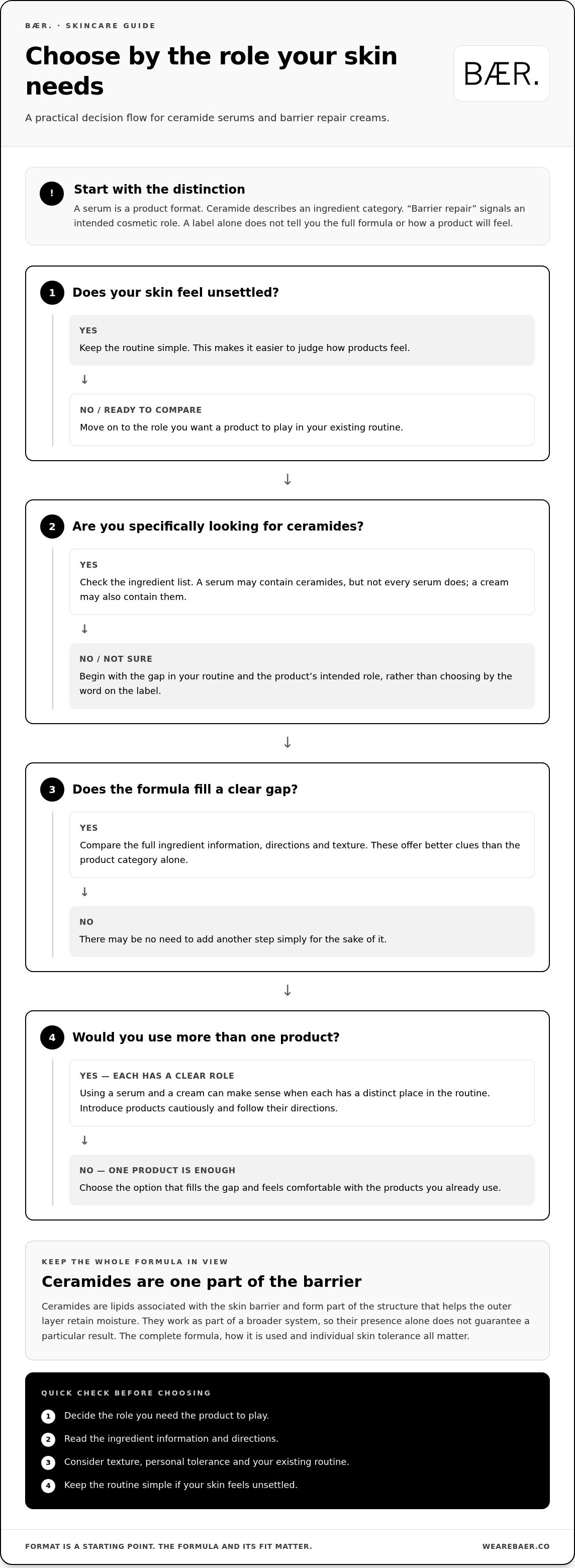
How to Choose and Layer a Ceramide Serum and Barrier Cream
A considered routine begins with what you already use, not with adding both formats by default. Use these steps to decide whether a new product has a clear place:
- Review your current routine. Note your cleanser, moisturiser and any products that may already serve the role you’re seeking.
- Choose one role to fill. Decide whether you need a serum step or a cream-format moisturiser, guided by the formula and your texture preference.
- Introduce one product at a time. This makes it easier to identify which product may be linked to a change in how your skin feels.
- Observe and adjust. If your skin feels uncomfortable or the routine becomes hard to assess, simplify rather than adding more layers.
Can you use a ceramide serum and barrier cream together?
They may fit into the same routine if both products suit your skin and their directions allow it. As general guidance, lighter-textured products are often applied before richer ones, so a serum may go before a cream. Texture varies, however, and this isn’t a rule that overrides product instructions. Apply each product as directed and allow the layers to settle comfortably.
Layering isn’t essential. If your existing moisturiser already suits your routine, you may not need another step. If using both makes it difficult to tell how your skin is responding, pause one product and keep the routine simple. For more context on recognising possible signs of barrier irritation, read our skin barrier signs and recovery guide.
How should you introduce a new barrier-support product?
Follow the product’s directions, including any patch-testing guidance, and introduce one new product at a time. Avoid changing several parts of your routine together; otherwise, it can be harder to work out what your skin is responding to. Pay attention to how your skin feels and looks, and discontinue use if you experience a concerning reaction.
For ceramide serum vs barrier repair cream, a gradual approach is more useful than assuming that more layers mean better support. Persistent or severe symptoms warrant advice from an appropriate healthcare professional, such as a GP or pharmacist.
If a cream format is the step you’re considering, explore MANTLE The Barrier Cream at BÆR. Review its product information and directions as part of deciding whether it belongs in your routine.
Finding a Barrier Repair Cream That Fits Your Routine
A useful cream is one that makes sense within your existing routine and feels comfortable to use. In the ceramide serum vs barrier repair cream decision, there’s no universally best format: the right choice depends on the formula, the step you need and how your skin tolerates it.
Before choosing, consider four things: what the product contains, how its directions fit your routine, whether you enjoy its texture, and how your skin responds. A cream might be a practical moisturiser step if you prefer that format; a serum may have a place if it serves a different purpose in your routine. Neither label alone guarantees a particular result.
What should you look for on a barrier cream label?
Read the full ingredient list and directions rather than relying on front-label wording such as “barrier repair”. Check for ingredients you recognise or have previously found comfortable, and consider whether the product’s stated use fits alongside your existing skincare. Don’t assume a cream contains ceramides simply because it’s described as barrier-focused, or that one ingredient guarantees a specific outcome. The complete formula matters.
MANTLE The Barrier Cream is a cream-format option available at BÆR. Use its product information to understand the formula and directions, then decide whether they suit your preferences.
When is tailored skincare guidance helpful?
If skin concerns persist, worsen or cause significant discomfort, seek advice from an appropriate healthcare professional. A skincare professional can also help you think through product choices and routine preferences, but a facial is not a substitute for medical care when symptoms need assessment.
The MANTLE by BÆR Bespoke Facial offers a professional skincare experience at BÆR. For a considered next step, explore MANTLE The Barrier Cream and its product information, alongside the wider curated skincare edit. Choose calmly, and let your routine’s needs, rather than a product label alone, guide the decision.
Choose the Routine That Feels Right for Your Skin
The key to ceramide serum vs barrier repair cream is to look beyond the format: a serum and a cream may serve different purposes, but their ingredients and effects depend on the complete formula. Start with the step your routine actually needs, review product information and directions, and introduce one new product at a time. You don’t have to layer both if a simpler routine feels more comfortable.
BÆR. stocks MANTLE The Barrier Cream as a cream-format option and offers the MANTLE by BÆR Bespoke Facial for a professional skincare experience. Neither replaces medical advice when skin concerns persist or cause significant discomfort.
Explore the curated skincare edit at BÆR. A thoughtful routine needn’t be complicated. Choose with care, give your skin time to respond, and let comfort guide your next step.
Frequently Asked Questions
Is a ceramide serum better than a barrier repair cream?
Neither is automatically better; the right choice depends on the formula and your routine. In the ceramide serum vs barrier repair cream comparison, a serum and a cream are different formats, but neither label guarantees particular ingredients or results. Review the full ingredient list and directions, then consider whether you need a serum step or a moisturiser and which texture you prefer. No single format suits everyone.
Can you use a ceramide serum and barrier repair cream together?
Yes, they may be used together if both suit your routine and their directions allow it. Introduce one product at a time and observe how your skin responds before adding another. A serum doesn’t necessarily need a cream on top, and layering both isn’t essential. If the combination feels uncomfortable or makes it difficult to identify what your skin is responding to, simplify your routine and reassess.
What should you apply first, a ceramide serum or barrier repair cream?
Follow the directions on both products first. As a general guide, people often apply lighter-feeling products before richer-feeling ones, which may mean serum before cream. Formulas and textures vary, though, so this isn’t a universal rule. If a product gives a specific order, follow that guidance. Introduce products gradually, rather than changing several steps at once, to make it easier to notice how your skin responds.
Do all barrier repair creams contain ceramides?
No. “Barrier repair cream” describes a product category or intended cosmetic role, not a standard ingredient list. Formulas vary, so check the complete list of ingredients rather than assuming ceramides are included. The same principle applies to a product labelled as a ceramide serum: its other ingredients also shape the formula. Assess the individual product and its directions, not just the wording on the front of the packaging.
Can a ceramide serum replace moisturiser?
It depends on the serum’s formula, its directions and what feels comfortable in your routine. The word “serum” doesn’t establish that a product can replace a moisturiser, and serum textures and formulations vary. Consider whether you already have a moisturising step and whether it meets your preferences. You don’t need to add or remove products solely because of their format; follow the product guidance and assess your routine as a whole.
How do you know whether to stop using a new skincare product?
Stop using a new product if it causes discomfort, irritation or an unexpected reaction, and follow any relevant guidance on its label. Introducing one product at a time can make it easier to identify what may have contributed. Don’t rely on cosmetics to diagnose or treat a skin condition. If symptoms are persistent, severe or worsening, seek advice from an appropriate healthcare professional, such as a GP or pharmacist.
Are ceramide serums suitable for sensitive skin?
Not necessarily; the word “ceramide” alone can’t establish whether a complete formula will suit your skin. Review the ingredient list and directions, and introduce the product cautiously, following any patch-testing guidance on its label. Stop if you notice a concerning reaction. Skin sensitivity varies, so avoid assuming that one ingredient or product format is suitable for everyone. For persistent or significant symptoms, seek advice from an appropriate healthcare professional.