
Could facial oil belong anywhere other than the final step? Not always. If you’re wondering how to layer facial oil over water based serum, the best order depends on the formulas, their directions and how your skin feels, rather than a rigid rule. Applying the products in a considered sequence can help you use both without a heavy finish or frustrating pilling.
It’s understandable to wonder whether oil might stop a water-based serum from working, or whether another layer will leave your skin feeling slick. A practical starting point is to apply serum first, let it settle, then smooth on a small amount of oil. Product instructions and textures still matter, so adjust the sequence if the labels say otherwise or the layers don’t feel comfortable together.
This guide covers application order, how to judge when the serum has settled and how much facial oil to start with. You’ll also find ways to adapt the routine for morning or evening, where moisturiser and sunscreen fit, and what to do if products pill. The aim is a routine that feels comfortable and is easy to adjust when your skin or products change.
Key Takeaways
- Learn how to layer facial oil over water based serum by applying each product separately and letting the serum settle first.
- Use product directions to decide where moisturiser fits. Formulas can behave differently, so one order won’t suit every routine.
- Mixing serum and oil may feel different from applying them in separate layers.
- Adapt your routine to the time of day, with sunscreen as the final skincare step before daytime makeup.
- Let your skin’s comfort guide whether facial oil belongs in your routine at all.
How Facial Oil and Water-Based Serum Work Together
Serum and facial oil can play different roles in a routine, but their names alone don’t tell you exactly how they’ll feel or behave. A water-based serum is often light, fluid or gel-like, while a facial oil usually feels richer and more lubricating. Skincare also comes in varied forms, including emulsions and dispersions, as the overview of Cosmetics describes. The finished formula matters as much as the product category.
What does a water-based serum do?
A serum is generally designed as a focused layer in a skincare routine, but “serum” doesn’t guarantee a particular texture, ingredient list or effect. Some formulas include humectants, ingredients that attract and hold water. Glycerin and hyaluronic acid are familiar examples, though their presence and performance depend on the specific formula and how it’s used. Other serums may contain different ingredients or feel creamy rather than watery.
Humectants help support water in the skin; oil-based emollients help soften its surface. This distinction is a useful guide, not a promise that every serum hydrates in the same way or every oil behaves identically.
What does facial oil add to a routine?
Facial oil can lend a supple, softened feel and complement the moisturising steps around it. Depending on its composition and the overall formula, an oil may also reduce moisture loss from the skin’s surface. Oils differ in how emollient or occlusive they feel, and other ingredients in a finished product can affect its texture and behaviour.
It’s too simple to say that every oil seals in every serum ingredient. How the products interact depends on both formulas, the amount applied and the skin beneath them. An oil that feels comfortable over one serum may sit heavily or pill with another. Follow the directions for each formula and pay attention to how your skin responds.
This is the principle behind how to layer facial oil over water based serum: consider the products’ textures and instructions, rather than relying on an inflexible rule that all oils must always come last. A light serum may settle quickly, while a richer or film-forming formula could affect how the next layer sits. If the combination feels slick, uncomfortable or uneven, use less or simplify the routine instead of forcing another step.
Layering is optional, too. Your skin doesn’t need both product types simply because they can be used together. Choose a combination that feels comfortable and fits the routine you want to maintain. The next section turns these differences into a practical application sequence.
How to Layer Facial Oil Over a Water-Based Serum: Step by Step
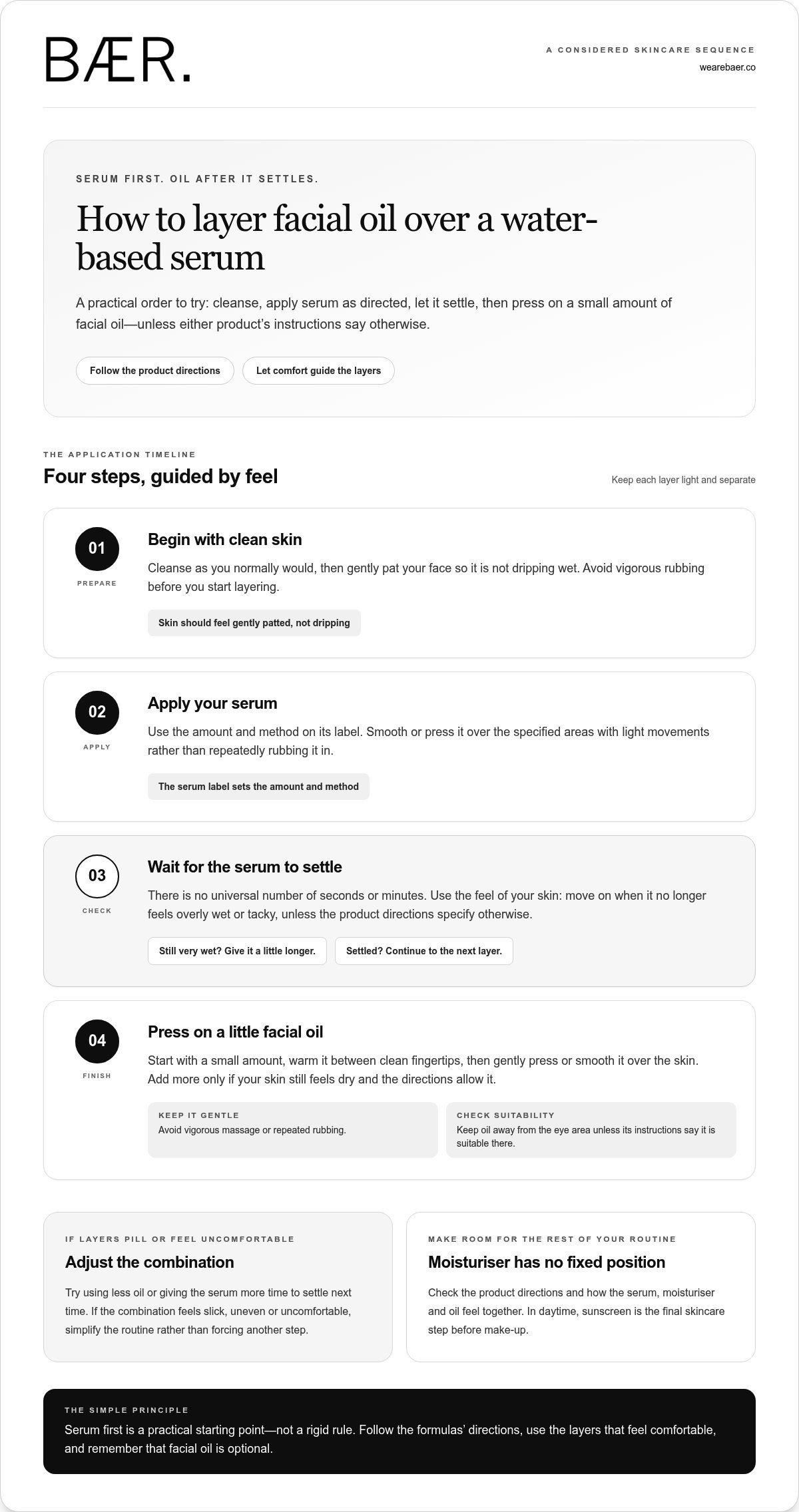
A simple sequence makes it easier to apply each layer evenly without overworking the skin. Cleanse, apply serum as directed, let it settle, then press on a small amount of facial oil, unless either product’s instructions say otherwise. Use this as a practical starting point, not a rule that overrides the product directions.
- Begin with clean skin. Cleanse as you normally would, then gently pat your face so it isn’t dripping wet. Avoid vigorous rubbing, which can leave skin feeling uncomfortable before you begin layering.
- Apply your serum. Follow its label for the amount and method. Smooth or press it over the areas specified, using light movements rather than repeatedly rubbing it into the skin.
- Give the serum time to settle. There’s no universal number of seconds or minutes that works for every formula. Wait until your skin no longer feels overly wet or tacky, unless the product directions specify otherwise.
- Apply a little oil. Start with a small amount, warm it between your fingertips, then gently press or smooth it over the skin. Add more only if your skin still feels dry and the product directions allow it.
How long should you wait between serum and facial oil?
Use the feel of the layers as your guide. If the serum is still very wet, give it a little longer. Once it has settled, you can move on. If the products start to pill or the combination feels uncomfortable, try less oil or give the serum more time to settle next time. The manufacturer’s directions take priority over a fixed routine tip. MedlinePlus explains that cosmetics that treat or prevent diseases are also drugs, a reminder to read product labels rather than treating every serum as interchangeable.
How much facial oil should you apply?
Begin with a small amount. It’s easier to spread and less likely to leave a slick finish, and you can add more if your skin still feels dry and the directions allow it. Warm the oil between clean fingertips, then gently press it across the face or smooth it over the areas you want to treat. Avoid vigorous massage or repeated rubbing, particularly if the serum underneath starts to move or pill. Keep oil away from the eye area unless its instructions explicitly say it’s suitable there.
Moisturiser doesn’t have one fixed position in every routine. Check the directions and consider how the serum, moisturiser and oil feel together. A richer formula may already provide a comfortable finish, while another routine may call for moisturiser after serum and before oil. If you’re refining your skincare routine, explore BÆR.’s curated skincare selection as a starting point for discovering products.
Should You Mix Facial Oil with Serum or Apply It Afterwards?
Applying serum and facial oil in separate layers gives you more control over the amount of each product and how the combination feels. Mixing them in your palm may save a step, but it changes how the products are combined before they reach your skin. Formulas vary, so a mixture that spreads comfortably with one pair of products may feel greasy, uneven or less pleasant with another.
There’s no need to assume that facial oil automatically blocks every serum from working. Applying oil over serum is a common approach, but it doesn’t guarantee enhanced results. The outcome depends on the formulas, how you apply them and their directions. When deciding how to layer facial oil over water based serum, follow each product’s instructions rather than assuming all water-based and oil-based formulas behave alike.
| Method | Potential benefit | Limitation | When to choose it |
|---|---|---|---|
| Apply in separate layers | Lets you adjust the amount of each product and observe how they sit on the skin. | May take longer, and the layers can still pill if formulas or application methods don’t suit each other. | As a considered starting point, especially when trying a new combination. |
| Mix before applying | Can feel convenient and may make application seem quicker. | The texture and spread may change; product directions may not recommend mixing. | Only if both products’ instructions allow it and the combination feels comfortable. |
Does facial oil stop a serum from working?
Not necessarily. Oil over serum doesn’t automatically prevent the serum from doing its intended job, but neither does layering promise better results. Follow the directions and notice how the combination behaves on your skin. If you notice irritation or persistent pilling, simplify the routine and reconsider whether the products feel comfortable together.
What should you do if products pill or feel greasy?
Start by using less product. Let each layer settle before applying the next, and remove steps that aren’t needed. Check whether either product specifies an application order or method, as textures and instructions differ between formulas. If discomfort persists, stop using the combination and consider whether other routine steps may be contributing. BÆR.’s guide to signs of a damaged skin barrier offers further information to help you reflect on what your skin is experiencing.
How to Adapt Serum and Facial Oil Layering to Your Routine
The right routine is one that feels comfortable and fits the rest of your day. Facial oil is optional: if your skin feels settled with serum and moisturiser alone, there’s no need to add another layer. When testing a new combination, introduce one change at a time so you can tell which product affects the finish or how your skin feels.
Can you layer facial oil over serum in the morning?
You can, if the product directions allow it and the layers feel comfortable beneath makeup. Use a modest amount if extra richness makes your base feel slippery or causes products to sit unevenly. Give skincare time to settle before applying makeup, and simplify the layers if they pill.
Facial oil does not replace sunscreen. Apply sunscreen after your skincare as the final skincare step before makeup, following its label for how much to use and when to reapply. Don’t mix facial oil directly into sunscreen: doing so can change how the sunscreen applies, and oil itself doesn’t provide UV protection.
How should you adjust layering for different skin needs?
Respond to how your skin feels rather than assigning facial oil to a particular skin type. If your skin feels oily or congested, try less oil or leave it out to see whether the routine feels more comfortable. If your skin feels dry, first consider whether your serum and moisturiser steps work well together. Adding oil isn’t the only possible adjustment.
Introduce unfamiliar products one at a time and follow their directions, including any patch-testing guidance. If you notice a reaction, stop using the product. If your skin remains uncomfortable, simplify your routine rather than adding more layers. A useful way to think about how to layer facial oil over water based serum is to make small, considered adjustments and observe how your skin responds over time.
For daytime, keep the finish practical and sunscreen consistent. In the evening, you may have more flexibility to try an optional oil layer, provided the products’ instructions and your skin’s comfort support it. There’s no requirement to use the same combination morning and night.
If you’d like a more individualised approach to your skincare routine, explore the MANTLE by BÆR. Bespoke Facial.
Build a Considered Serum-and-Oil Routine That Suits Your Skin
A thoughtful routine doesn’t need to be complicated. Follow each product’s directions, apply layers with care and let your skin’s comfort guide any adjustments. Learning how to layer facial oil over water based serum is a starting point, not a prescription. Formulas differ, and serum and moisturiser may be enough for your skin.
When is a simpler skincare routine the better choice?
If your routine feels heavy, uncomfortable or difficult to maintain, remove optional layers and return to the products that feel comfortable. Facial oil is an extra step, not a requirement. Simplifying can also make it easier to work out what suits you, particularly if you’ve added several products at once.
Change one product or step at a time, then observe how your skin feels before making another adjustment. For example, try using less oil before changing your serum and moisturiser as well. If discomfort persists or you have ongoing concerns about your routine, professional skincare guidance can help you consider a more individualised approach.
How can a considered skincare edit support your routine?
A curated selection can make skincare discovery feel more focused. BÆR. is an independent luxury beauty retailer with a considered edit of premium beauty brands. Its skincare selection includes products such as MANTLE The Barrier Cream alongside hydrating water-based serums designed to prep and balance the complexion.
For those seeking a more personalised skincare experience, the MANTLE by BÆR Bespoke Facial offers an in-store treatment with an individualised focus. It’s a way to explore skincare with professional attention, without assuming that one layering sequence or combination will suit everyone.
Keep the routine that feels balanced, and leave out any layer that doesn’t earn its place. If you’re ready to discover a considered edit of beauty and skincare, explore BÆR.
Make Your Routine Feel Considered
The key to how to layer facial oil over water based serum is to treat product directions as your guide, rather than following a rigid rule. Apply serum as directed, let it settle, then try a small amount of oil if it feels comfortable. Moisturiser placement depends on the formulas, and facial oil is an optional step, not a necessity.
If layers feel heavy or pill, use less, simplify and adjust one step at a time. In the daytime, sunscreen remains the final skincare step before makeup. A routine should feel comfortable enough to maintain, with each product earning its place.
BÆR. brings together a curated selection of premium beauty brands, including DANESSA MYRICKS BEAUTY Yummy Skin Water Powder Serum. For a more individualised skincare experience, the MANTLE by BÆR Bespoke Facial offers a considered in-store option.
Explore BÆR.’s considered edit of beauty and skincare, and build a routine that feels right for you.
Frequently Asked Questions
Should facial oil go before or after a water-based serum?
Usually, apply a water-based serum first and facial oil afterwards, but follow the directions for both products. This is a useful starting point for how to layer facial oil over water based serum, not a rule for every formula. Let the serum settle before applying a small amount of oil. If either product specifies a different order, or the combination feels uncomfortable, adjust your routine accordingly.
How long should I wait between applying serum and facial oil?
There’s no fixed waiting time that suits every product. Allow the serum to settle until your skin no longer feels overly wet or tacky, then apply the oil if its directions permit. A formula’s texture and instructions are more useful guides than a set number of minutes. If the products pill, feel uncomfortable or remain unusually slippery, try using less or allowing more time between layers.
Can facial oil stop a water-based serum from working?
Not necessarily. Applying facial oil over serum doesn’t automatically stop the serum from working, but layering also doesn’t guarantee better results. How the products feel together depends on their formulas, directions and application. Use each as instructed and watch how your skin responds. If the combination causes irritation or persistent pilling, simplify your routine and reconsider whether both products suit the same routine.
Can I mix facial oil into my serum instead of layering them?
Only mix them if the product directions allow it. Combining products in your palm may be convenient, but it can change their texture and how evenly they spread. Formulas don’t all interact in the same way, so don’t assume a serum and oil will work well mixed together. Applying them separately lets you control the amount of each and notice how the layers feel on your skin.
Can I use facial oil over serum in the morning?
Yes, if the product directions allow morning use and the layers feel comfortable beneath makeup. Use a modest amount if oil makes your base feel slippery or uneven. Apply sunscreen after your skincare as the final skincare step before makeup, following its label for application and reapplication. Don’t mix oil into sunscreen or rely on facial oil for UV protection; it doesn’t replace sunscreen.
Should I apply moisturiser before or after facial oil?
There isn’t one universal order, because products vary in texture and directions. Check the labels for your serum, moisturiser and oil, then consider how the layers feel together. One routine may place moisturiser before oil; another may work better with a different sequence. If your skin feels coated or the products pill, use less or remove an optional layer rather than adding more products.
Can I layer facial oil over serum if I have oily or blemish-prone skin?
You can try it if the products’ directions allow, but facial oil is optional and won’t suit everyone’s routine. Begin with a very small amount, or leave it out if your skin feels greasy or congested without it. Introduce one change at a time so you can observe the result. If a product causes irritation or discomfort, stop using it and reassess the combination.