
What if the very product you rely on for a radiant glow is actually the silent architect of those frustrating, under-the-skin bumps? It's a common paradox. You invest in premium hydration to achieve a dewy finish; yet, you find your reflection marred by a pebbled texture that refuses to clear. We understand the frustration of identifying the subtle signs your moisturiser is clogging your pores when your routine feels otherwise impeccable. It feels counterintuitive to think that your source of comfort could be causing distress.
You deserve a complexion that feels as light as it looks. In this expert guide, you'll discover how to interpret your skin's signals and distinguish between healthy hydration and true congestion. Beyond the immediate signs your moisturiser is clogging your pores, we'll explore the science of formulation balance and how to audit your ritual for lasting clarity. By understanding the 28-day biological cycle, you can move beyond the noise of generic labels. We will provide a refined approach to identifying the signs your moisturiser is clogging your pores, guiding you from immediate concern to a bespoke, high-performance solution.
Key Takeaways
- Learn to decode the physical manifestations of congestion, distinguishing between healthy radiance and the subtle signs your moisturiser is clogging your pores.
- Explore the science of comedogenicity to understand why the overall formulation matrix is more significant than any single raw ingredient.
- Uncover the impact of high-potential congestors such as Isopropyl Myristate and learn how to vet your skincare for molecular mismatches.
- Implement a methodical routine audit to safely isolate culprit products and restore your complexion’s natural luminosity.
- Transition towards a bespoke, barrier-focused regimen that utilises niche, high-performance ingredients to prevent future pore blockages.
Identifying the Subtle Indicators of Pore Congestion
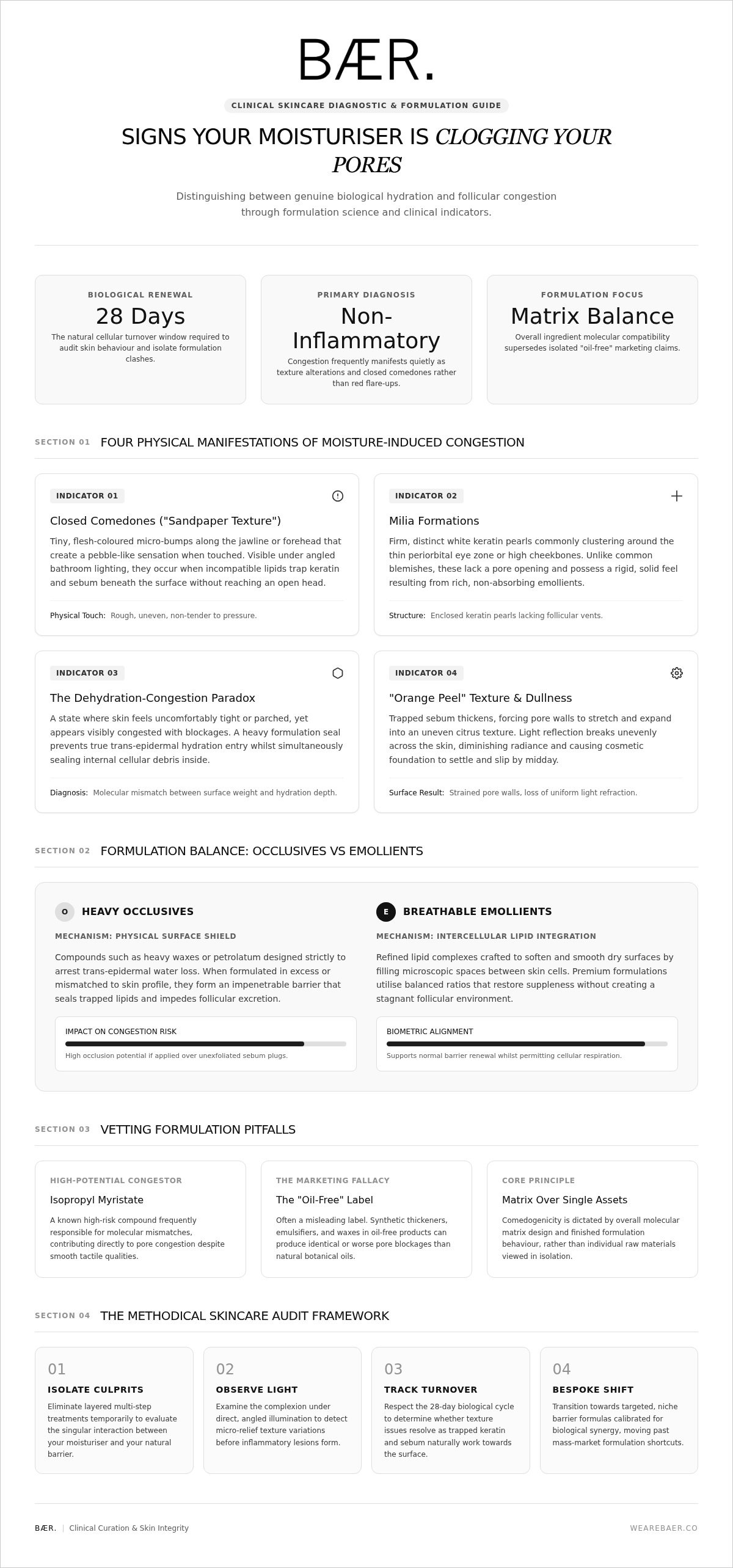
Skin congestion isn't always a loud flare-up. Often, it's a quiet shift in how light hits your face. One of the most telling signs your moisturiser is clogging your pores is the arrival of closed comedones. These aren't your typical red spots. They're tiny, flesh-coloured bumps that create a "sandpaper" feel when you run your fingers over your jawline or forehead. Under angled bathroom lighting, your skin might look pebbled or uneven despite your best efforts to hydrate. This texture is a physical manifestation of a routine that's no longer serving your skin's unique needs.
Understanding the formation of comedones is essential for anyone seeking clarity. These blockages occur when sebum and keratin become trapped within the follicle, creating a plug that never reaches the surface. It's a biological backup that disrupts the natural flow of your skin's ecosystem. When your moisturiser is too heavy or contains incompatible lipids, it effectively seals these plugs in place, preventing the skin from completing its natural renewal process.
Beyond the Breakout: Non-Inflammatory Clogs
Milia are often mistaken for standard congestion. These are firm, white keratin pearls that typically nestle around the eyes or high on the cheekbones. Unlike a standard blemish, they lack a visible pore opening and feel remarkably hard to the touch. You might also notice a confusing sensation where your skin feels tight or dehydrated, yet looks visibly congested. This usually points to a formulation mismatch. Your moisturiser might be too heavy for your skin's natural oil production, creating a seal that prevents moisture from entering whilst trapping debris inside. It's a temporary reaction that can lead to long-term texture issues if left unaddressed.
Texture Changes and the Loss of Radiance
True radiance comes from a smooth surface that reflects light evenly. When you experience the first signs your moisturiser is clogging your pores, that "lit-from-within" glow begins to fade. It's replaced by a persistent dullness. You might notice an "orange peel" texture, where pores appear enlarged and strained because they're struggling to breathe beneath heavy occlusive layers. This happens when sebum is held captive. Instead of flowing freely to the surface, it thickens and stretches the pore walls. Makeup often provides the final diagnostic clue. If your foundation suddenly settles into pores or appears patchy by midday, it's likely reacting to the congestion brewing beneath the surface.
The Science of Comedogenicity and Formulation Balance
Comedogenicity is a term often whispered in dermatology clinics, yet it remains widely misunderstood by the casual consumer. At its core, it refers to the physiological probability that a specific ingredient or finished formulation will induce a blockage within the hair follicle. Understanding the causes of clogged pores is less about blacklisting individual items and more about understanding molecular weight and formulation intent. When a product sits too heavily on the surface without integrating into the skin's lipid structure, it can create a stagnant environment where sebum cannot escape.
High-performance skincare has evolved beyond the dense, suffocating textures of the past. Modern chemistry allows for sophisticated, breathable barriers. These formulations provide essential protection whilst allowing the skin to perform its natural excretory functions. If you find your face feels perpetually "coated" or heavy, these are early signs your moisturiser is clogging your pores. It suggests a molecular mismatch where the product is failing to biometrically align with your skin's own behaviour.
Understanding Occlusives vs. Emollients
The delicate dance between occlusives and emollients dictates how a cream interacts with your texture. Occlusives, such as heavy waxes or petrolatum, create a physical seal to prevent trans-epidermal water loss. Whilst vital for compromised barriers, they can act as a trap for those prone to congestion. Emollients, conversely, are designed to soften and smooth by filling the gaps between skin cells with lipids. A superior moisturiser uses a refined ratio of these components, ensuring the skin feels supple rather than smothered. Achieving this balance is a hallmark of the expertly curated selections found in our boutique.
Why 'Oil-Free' is Often a Misleading Label
The "oil-free" badge has long been used as a marketing shortcut for acne-prone skin, but it's a simplification that often leads to further congestion. Many synthetic thickeners and waxes found in oil-free products possess a higher comedogenic potential than pure, linoleic-rich botanical oils. Identifying the signs your moisturiser is clogging your pores requires a shift in perspective; you must look past the "oil-free" label and toward how the formulation actually behaves on your unique complexion. True skin clarity comes from focusing on non-comedogenic testing and formulation stability rather than a blanket exclusion of oils. By choosing products that mimic natural skin lipids, you provide hydration that the skin recognises and absorbs, rather than a foreign layer that triggers a defensive, congestive response.
Common Culprits: Ingredients That May Compromise Clarity
The tactile experience of a thick, velvet-textured night cream often suggests a sense of opulence and efficacy. However, the ingredients required to achieve that specific "slip" can be problematic. Synthetic thickeners, particularly Isopropyl Myristate and its derivatives, are frequently utilised to enhance the sensory profile of a product. Whilst they provide an immediate smoothing effect, they possess a high comedogenic potential. These esters can penetrate the follicle and trigger the hyper-keratinisation that leads to the very first signs your moisturiser is clogging your pores. It's a classic case of aesthetic appeal overriding biological compatibility.
Coconut oil is another common offender. Whilst it's a celebrated miracle for body care, its high concentration of lauric acid makes it a frequent clogger for facial skin. It forms a dense, occlusive film that many complexions simply cannot tolerate. Similarly, certain silicones and heavy waxes used to create a "luxurious" feel can act as a physical plug. These substances can trap sweat, bacteria, and sebum against the skin's surface. This creates a stagnant environment that leads to "congestion breakouts"—those stubborn, non-inflammatory bumps that seem to appear overnight and refuse to budge.
Synthetics vs. Natural Heavyweights
A discerning eye is required when navigating the "natural" skincare market. Algae extract, for instance, is often prized for its mineral content, yet certain species are surprisingly linked to follicular blockages. Even revered ingredients like Lanolin present a dual nature. It is an exceptional choice for addressing the signs of a damaged skin barrier, providing unparalleled protection and repair. Yet, for those with a predisposition to acne, its heavy, sheep-derived lipids can be too occlusive. The secret to a clear complexion is finding high-performance alternatives that offer restorative benefits without compromising the skin's ability to breathe.
The Role of Fragrance and Preservatives
The sensory allure of a scented cream is undeniable. Yet, the essential oils used to create these luxury aromas can act as inflammatory triggers. There is a vital distinction between a "scent" and an "active botanical" in a sophisticated formulation. When a fragrance causes low-grade inflammation, it can disrupt the skin's excretory flow, contributing to the signs your moisturiser is clogging your pores. Identifying whether your skin is reacting to the base formula or the botanical bouquet is a crucial step in refining your ritual. We believe a truly refined product prioritises biological health over a fleeting olfactory experience.
How to Audit Your Skincare Routine for Congestion
Identifying the precise culprit in a multi-step regimen requires a methodical, almost clinical approach. The 'Elimination Method' is your most reliable diagnostic tool. By removing your primary hydrator for one full epidermal cycle, you allow the skin to reset. This period of observation is crucial. It helps you determine if those subtle textures are truly signs your moisturiser is clogging your pores or if they stem from another source. If you notice a gradual reduction in new closed comedones during this hiatus, you've successfully isolated the offender.
Patience is a requirement when auditing your ritual. Because human epidermal turnover averages 28 to 40 days, you shouldn't judge a new product within its first week of use. It takes time for the skin to react. Clinical data suggests that cosmetic-induced microcomedones can take 2 to 4 weeks to mature into palpable surface bumps. Conduct a sophisticated patch test on your jawline, an area notoriously prone to congestion, and observe the results over a full month. Adjusting your application technique can also prevent product build-up; try pressing the cream into the skin rather than rubbing it to ensure even distribution without overloading the follicles.
Reading Your Skin's Daily Behaviour
Your skin communicates its needs through its midday appearance. If your face feels 'greasy' or heavy by noon, it suggests your moisturiser is sitting on the surface rather than integrating into the lipid barrier. Track the location of any new bumps. If they appear exclusively where you apply your heaviest creams, the correlation is clear. A thorough double-cleanse each evening is non-negotiable. It ensures that every trace of occlusive residue is removed, preventing the overnight fermentation of trapped sebum and bacteria.
Transitioning to Breathable, High-Performance Textures
Modern skincare innovation has moved beyond the heavy, suffocating creams of the past. We now have access to textures that provide deep hydration with a weightless finish. Water-powder serums are a particular revelation for those with oily-leaning skin. The Danessa Myricks Water Powder Serum serves as a modern alternative, offering a soft-focus effect whilst allowing the pores to breathe. Lightweight gel-creams are equally effective, maintaining the moisture barrier without creating a congesting seal. To begin your journey toward a more refined complexion, explore our curated edit of barrier-first essentials.
Bespoke Solutions: Curation Over Mass-Market Moisture
Curation is clarity. In an industry often saturated with mass-market fillers, the path to a refined complexion lies in a more deliberate selection of products. Niche beauty brands prioritising skin health and barrier repair offer a level of precision that high-street options frequently lack. Once you've identified the signs your moisturiser is clogging your pores, the next step isn't just to stop using the culprit; it's a strategic recalibration. The BÆR. approach filters the landscape to present only the finest formulations, ensuring every lipid and botanical serves a purpose and saving the customer from the noise of a crowded market.
A barrier-first strategy is the ultimate safeguard against future congestion. By choosing high-performance products like MANTLE The Barrier Cream, you provide your skin with the essential lipids it craves without the suffocating weight of traditional occlusives. This shift from generic hydration to targeted repair allows the skin to maintain its natural equilibrium. It's about quiet confidence in your routine, knowing that your moisture source is working with your biology rather than against it. A clear, luminous texture is the inevitable result of such a bespoke approach to skin health.
Professional Facials as a Diagnostic Tool
Sometimes, the skin requires a professional reset. The MANTLE by BÆR. Bespoke Facial acts as the ultimate diagnostic tool for complex skin concerns. During this immersive experience, our experts conduct a deep skin analysis to identify deep-seated congestion that topical home care might miss. We utilise professional-grade exfoliation and precise extractions to clear existing clogs, effectively turning back the clock on months of formulation mismatches. This treatment provides a personalised 'prescription' for your home ritual, ensuring you never again have to guess if a product is triggering the signs your moisturiser is clogging your pores. The result is a physical rejuvenation that feels both curated and thorough.
The Power of Targeted Skin Prep
Sophisticated hydration often begins long before you reach for a cream. By incorporating high-performance serums into your routine, you can deliver deep moisture to the lower layers of the epidermis. This often reduces the need for heavy, congesting top layers. At beauty stores like BÆR., we treat skincare with the same reverence as a niche fragrance boutique UK collectors might admire, prioritising efficacy and rare, high-quality ingredients over mass-produced fillers. This commitment to quality ensures that every step of your skin prep contributes to a healthy, refined complexion. Achieving a lit-from-within glow is simply a matter of choosing the right curator for your skin's journey.
Refining Your Ritual for Lasting Clarity
Achieving a clear, luminous complexion isn't a matter of chance; it's the result of a deliberate, informed selection of products that respect your skin's unique biology. We've explored how the subtle signs your moisturiser is clogging your pores, such as persistent dullness or a pebbled texture, often point to a molecular mismatch rather than a lack of hydration. By auditing your current regimen and looking beyond misleading mass-market labels, you can reclaim a texture that feels as light as it looks.
Our role at BÆR. is to act as your expert curator, vetting the landscape to present only the finest, barrier-first innovations. As luxury beauty authorities, we stock modern innovators like MANTLE and Danessa Myricks to ensure your routine prioritises efficacy over filler ingredients. For those requiring a deeper diagnostic reset, our in-store Bespoke Facials provide the professional analysis needed to clear existing congestion and organise a personalised path forward.
Discover our curated edit of non-congesting, high-performance skincare. Your journey toward a refined, healthy glow starts with a single, mindful choice.
Frequently Asked Questions
Can a moisturiser cause bumps but not pimples?
Yes, a moisturiser can certainly cause bumps without triggering inflammatory pimples. These are often closed comedones, which manifest as a pebbled or sandpaper-like texture beneath the skin's surface. Unlike standard acne, they lack redness and swelling. If you notice these subtle signs your moisturiser is clogging your pores, it suggests that heavy occlusives are trapping keratin and sebum within the follicle, preventing the natural shedding process without causing an immediate bacterial infection.
How long does it take for a moisturiser to clog your pores?
It typically takes between two and four weeks for a moisturiser to visibly clog your pores. While you might feel an immediate heaviness, the biological formation of a microcomedone requires time to mature into a palpable bump. This timeline aligns with the average 28-day epidermal turnover cycle. You shouldn't judge a new formulation after just a few days; persistent congestion usually becomes clinically detectable only after consistent application over several weeks.
Is it possible for a 'non-comedogenic' cream to still cause breakouts?
It's entirely possible for a product labelled "non-comedogenic" to cause breakouts, as there is no single mandated testing protocol in the UK. A label simply indicates the brand's own substantiation, but it doesn't guarantee compatibility with every complexion. Individual skin chemistry and the concentration of specific ingredients within the total formulation matrix play a far more significant role than a generic marketing claim found on mass-market packaging.
What should I do if I think my moisturiser is clogging my pores?
You should immediately begin an elimination audit to isolate the culprit. Remove the suspected product for at least one full skin cycle and observe if the texture improves. Transitioning to high-performance, breathable alternatives like MANTLE The Barrier Cream can provide necessary hydration without the risk of further congestion. For a definitive reset, a professional treatment like the MANTLE by BÆR Bespoke Facial can help clear existing clogs and refine your home ritual.
Should I stop using moisturiser if I have congested skin?
You shouldn't stop moisturising entirely, as dehydrated skin can actually worsen congestion. When the skin lacks moisture, dead cells don't shed efficiently, leading to further blockages. The solution is to switch to a lightweight, water-based serum or a breathable gel-cream. Products like the DANESSA MYRICKS BEAUTY Yummy Skin Water Powder Serum offer a sophisticated way to balance the complexion's hydration levels without creating a suffocating occlusive seal.
How do I tell the difference between purging and clogging?
The primary difference lies in the ingredients and the location of the bumps. Purging occurs when active ingredients like retinoids or AHAs accelerate cellular turnover, pushing existing clogs to the surface in areas where you usually break out. Conversely, if you notice signs your moisturiser is clogging your pores, bumps will appear in new areas and persist without the presence of exfoliating actives. Clogging is a reaction to formulation, not an accelerated healing process.
Can I 'fix' a clogging moisturiser by using less of it?
You can't "fix" a clogging formulation simply by applying less of it. If an ingredient like Isopropyl Myristate or coconut oil is molecularly incompatible with your skin, even a small amount can trigger follicular hyper-keratinisation. Congestion is often a result of the specific chemical interaction between the product and your sebum, rather than the volume applied. A better approach is to seek a formulation designed with bio-compatible lipids that integrate seamlessly into the skin.
Are natural moisturisers less likely to clog pores than synthetic ones?
Natural moisturisers aren't inherently safer for pore clarity than synthetic ones. In fact, many natural heavyweights like coconut oil and cocoa butter are highly comedogenic and frequently cause more congestion than modern, laboratory-refined synthetic esters. A truly sophisticated routine prioritises the molecular weight and stability of the formulation over a simple "natural" versus "synthetic" binary. We curate niche brands that balance botanical efficacy with high-performance, non-congesting science.